We are a local pickup only nursery. Please select location at checkout.
Honey Petal Plants
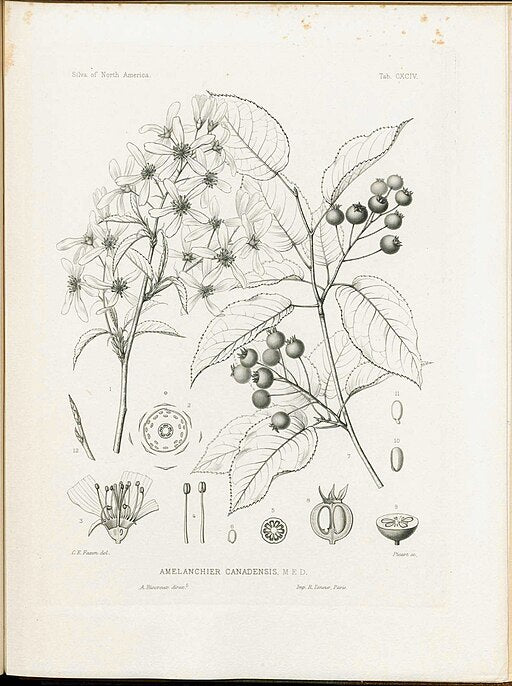
Amelanchier canadensis - Serviceberry
Amelanchier canadensis - Serviceberry
Couldn't load pickup availability
Sizes available: #1 (Trade gallon), recently up-potted, maybe fall, 2026
Basics: zones 4-7, at maturity 15-25' tall with a 15-20' canopy, part sun, dappled sun, part shade to shade, white flowers develop into dark purple berries (technically pomes) in early summer. Prefers consistent moisture, but is adaptable. Will flower best in part sun to part shade. Needs moisture in full sun to do well.
Common names: Serviceberry, Canadian Serviceberry, Shadblow, Shadbush, Juneberry, Wild Currant, Oblongleaf Juneberry, Chuckle-berry, Currant-tree, Sugar Plum, Thicket Shadblow
Family: Rosaceae
Origin/Distribution: eastern North America from Canada south to Georgia and west to Mississippi and eastern Tennessee. Native to Maine.
Habitat: Damp understory, edges of swamp, thickets, and low woods. But, if consistently moist can do well in full sun. Often grows in association with chokecherry, white oak, red cedar, speckled alder, or bayberry.
More: This is a beautiful early-blooming keystone native shrub/tree that offers so much to the ecosystem. As you can see from the species preferred habitat, Amelanchier canadensis likes a damp place, but although it can grow on a wetland edge, it does not need that to grow well and does not like standing water. Amelanchier arborea and Amelanchier laevis (both native and also widespread in Maine) can hybridize with this plant, but in my research it looks like they are more likely to hybridize with each other. Amelanchiers are the classic understory tree that you see blooming on the edge of the woods in the spring as you drive around Maine. The flowers look like little white butterflies fluttering about in the partial shade.
Serviceberry is important for pollinators, browsers, and berry-eaters. Because this is an early-bloomer it is very beneficial to pollinator and nectar-feeders at the front end of the season. If we think about browsers in the broadest terms this also includes caterpillars. Here are four butterflies and three moths common to Maine that use Serviceberry as a larval host: First two related species - White Admiral, Limenitis arthemis arthemis and Red-spotted Purple, Limenitis arthemis astayanax - interestingly, like Serviceberry, these two naturally hybridize where their ranges overlap, as in Maine. The Viceroy, Limenitis archippus and the Striped Hairstreak, Satyrium liparaps also use Serviceberry as a larval host, as do the Blinded Sphinx moth, Paonias excaecata, the Small-eyed Sphinx moth, Paonias myops, and the White-spotted Prominent moth, Nadata gibbosa. Because Serviceberry is in the Rose family, it is potentially a larval host to numerous species of non-specialist Lepidoptera. However, it may also attract our invasive Japanese Beetle, so be on the look out.
The berry-eaters include pretty much any bird or mammal quick enough to harvest the ripe fruit, including humans who have used it both fresh and dried, fermented into wine, and in pies and jams. Some of the common names indicate its tastiness. All of the common names are interesting. Shadbush and Shadblow refer to the timing of bloom coinciding with the migration of shad up coastal rivers in order to lay eggs. Serviceberry can refer to the thawing of the ground enabling funeral services to resume, or that snow has melted and roads are dry enough for traveling preachers to tend to remote communities. One source suggests it is called this because the flowering branches are used to decorate churches in the spring. All of these can be true. The roots have been used medicinally. Although the trunk girth is narrow, the wood is hard and can be used for fishing rods, walking sticks, and handles of all sorts. Can be grown as a shrub, multi-stemmed, or single-stemmed tree depending on pruning preferences. Exhibits mild-medium salt tolerance.
Even more: This plant will need to be protected from deer and bark-girdling rodents until it gets established, but it is well worth it for its spring beauty and ecosystem value. Some of my research suggests it is seldom browsed by deer, but young trees are VERY susceptible to deer browse in my experience. Just like Benjamin Franklin wrote in The Pennsylvania Gazette on 2/4/1735, "An ounce of prevention is worth a pound of cure." Although he is credited with popularizing this concept, I imagine there are aphorisms in numerous cultures going back centuries that advocate getting one's act together prior to disaster.
Source: Cold Stream Farm, 2026
Image credits: Wikimedia Commons